Notion Alternatives for AI-Native Teams
Jul 18, 2026
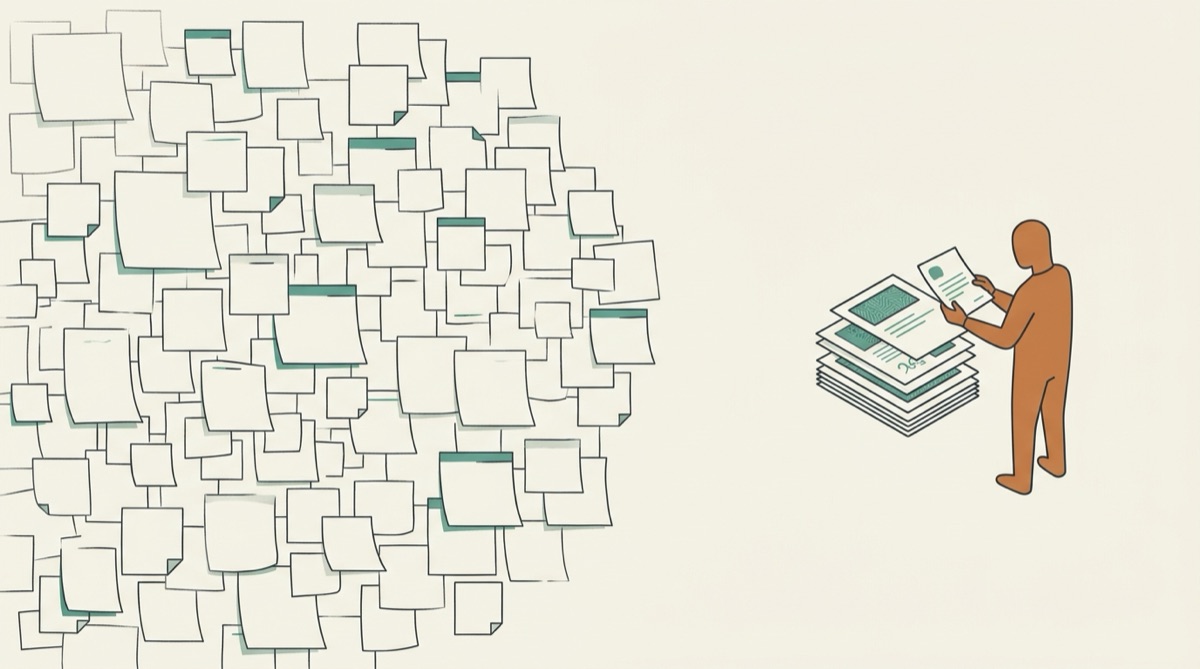
Most lists of Notion alternatives for teams are built to answer a question from 2019: which workspace has the nicer docs, databases, and wikis for people to read. That is a fair question if people are still your primary readers. On AI-native teams, they increasingly aren't. The reader is an agent — one that drafts your emails, researches your competitors, updates your ops trackers — and it opens your workspace fresh every session with no memory of what your team already worked out. Rank the alternatives on that axis and the order changes.
This piece covers the genuine Notion alternatives fairly, then adds the column those roundups leave out: does the tool serve your context machine-side, in a form agents can actually use.
Notion alternatives for teams: what the roundups optimize for
Search "best Notion alternatives" and page one is a wall of listicles — Zapier, Teamwork, Slite, Rock, Airtable — all comparing the same features: block editors, nested pages, databases, permissions, pricing tiers. They rank real, useful tools:
- Confluence — the enterprise wiki standard, strong for structured documentation and Atlassian shops. If you want the deeper comparison, see our Confluence alternatives breakdown.
- Slite — a cleaner, calmer doc workspace built around a searchable knowledge base for teams that found Notion too sprawling.
- Airtable — the pick when your "docs" are really structured data and you need database power more than prose.
- Rock, Teamwork, and similar — all-in-one workspaces that fold docs, tasks, and chat together for smaller teams.
These are honest recommendations for a human-first workspace. If your goal is a tidy wiki that people open, read, and edit, any of them can beat Notion for your specific taste. Nothing below argues otherwise.
The axis those lists miss: who is actually reading
Here is what none of the roundups measure. On an AI-native team, most of the reading is no longer done by people. It is done by agents, and agents have a different failure mode.
Almost every team has the same artifact: a Notion doc titled something like "our best prompts." It works for a month. Then the curve sets in. By month 3, new people open it, get overwhelmed, and go back to asking whoever wrote it — the "prompt wizard." By month 5, the library is stale and nobody trusts it. The problem was never the documentation tool. Prompts are only half the equation. A prompt document tells an agent how to do a task. It never tells the agent what the task means — your brand voice, your customers, the decision you reversed last week. Almost nobody has that second set systematized, and no amount of nicer nested pages fixes it.
The tools on those lists were built for humans who read a page once and internalize it. Agents don't internalize. They start from zero every session. So the question that actually separates these products for an AI-native team isn't "which has the better editor." It's "does this serve context to a machine, actively, in a form it can consume" — which is the difference between a wiki, something a person reads, and an agentic knowledge base, something an agent acts on.
Being fair to Notion
Notion earned its default status, and it is not standing still. It has shipped meaningful AI features and is doing more with agents than it was a year ago. Credit where it is due.
But the honest read, as of mid-2026, is that it feels tacked on. There is no active management around the agents or around the knowledge itself. You can point AI at your Notion, but nothing curates what the agents read, marks a superseded decision as superseded, or keeps the context dense instead of letting it sprawl. Notion — and Confluence with it — is largely where context goes to die for agents: everything gets dumped in, nothing gets pruned, and retrieval alone has to sort out the mess. That is the same failure curve as the prompt library, just at workspace scale.
This is the line that matters. The difference between a knowledge base and a company brain is active management — curating both the index and the content itself. Without it, "otherwise, it's just a knowledge base, and knowledge bases just get stale." Curation doesn't all have to be human; an LLM can help. But relying on search and retrieval alone is not good enough when the thing reading is an agent that will confidently act on whatever it finds.
Where an agent-native option fits
This is where Patina enters, and it is a genuinely different category rather than a nicer wiki. Patina is a company brain built for teams whose agents outnumber their readers. Instead of a workspace people browse, it is one shared context home — brand voice, customer personas, playbooks, and the decisions behind them — that every agent reads from over web, API, and MCP.
Two differences carry the weight:
One shared memory, actively curated. Not per-agent memory scattered across tools, and not a document dump. Context is human-curated through a review workflow — new material is proposed, reviewed, and merged, the way you manage code. Stale entries get archived. A reversed decision gets marked superseded so one agent doesn't pick up the old call while another picks up the new one. Managing context means managing decisions, not just documents. And every approval stays on the record: a piece of knowledge can show what it drew on, who let it in, and whether the decision behind it still stands — one connected trail no wiki keeps.
Built to be read machine-side. The same brain is served over an API and an MCP endpoint, so any agent on any surface pulls the same answer. It is not "AI bolted onto a doc tool." It is context designed for the reader that is actually doing the reading.
Here is the honest scorecard, both axes side by side:
| Human-first docs | Active curation of content | Shared memory across agents | Serves agents machine-side | |
|---|---|---|---|---|
| Notion | Excellent | No | No | Improving, feels tacked on |
| Confluence | Strong (enterprise) | No | No | Limited |
| Slite / Rock / Airtable | Good, varies | No | No | Not the design goal |
| Patina | Basic by comparison | Yes (human review + LLM-assisted) | Yes | Yes (web + API + MCP) |
Read that table honestly. If you want the best human writing surface, Patina is not it, and the roundups are right to send you to Notion or Slite. Patina wins exactly one column set — the agent-facing ones — and that only matters if your agents have become your primary readers.
How to actually choose
Ask one question before you migrate anything: who reads this most, people or agents?
If the honest answer is still people — you are documenting for humans who will read and internalize — pick from the standard lists. Optimize for the editor and the price, and you will be happy.
If the honest answer is agents — you have gone all-in on AI for content or ops, and the bottleneck is that every agent produces generic output because it doesn't know the first thing about your business — then the comparison axis has changed underneath you, and none of the roundups measure the thing you need. You want a curated AI knowledge base that agents read from, not a prettier place to store prompts that go stale by month 5. (If the tool your team really lives in is a chat app, that's a different comparison — see ChatGPT Team alternatives.)
Patina is $79/mo, self-serve, and built for that second case. You can see the pricing and decide. But the more valuable takeaway costs nothing: the reason your "best prompts" doc keeps failing is not the tool you chose. It is that you documented the how and never systematized the what — and switching from one human-first workspace to another won't change that.