AI Workspace Alternative to ChatGPT Team, Compared
Jul 18, 2026
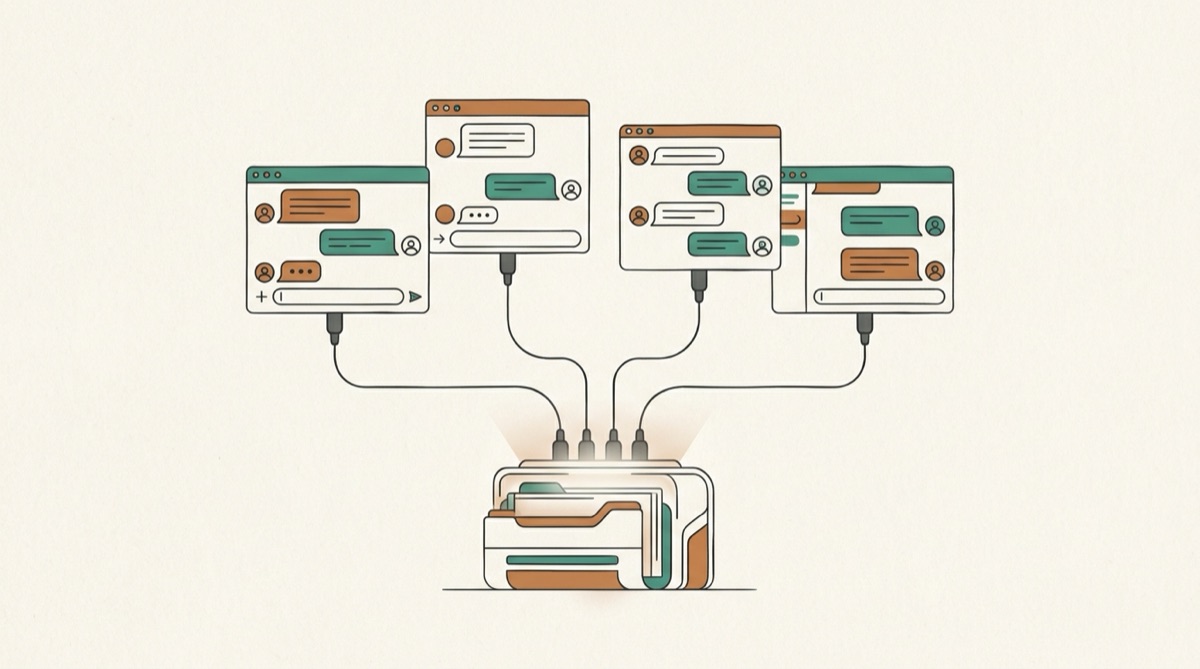
If you're shopping for an AI workspace alternative to ChatGPT Team, you've probably already felt the reason you're looking. The seats got bought. Access went out to the whole team. And a few weeks later, two or three people are getting real work done while everyone else opens a blank chat box and closes it again. Most of the alternatives on page one — TeamAI, Vellum, Aymo, AICamp — fix a real thing: they give you more model choice and a nicer team chat UX than ChatGPT Team alone. But none of them fixes the thing that actually stalled your rollout.
Why teams look for an alternative to ChatGPT Team
The pattern is boringly consistent. A company buys ChatGPT Team, or Claude Enterprise, or one of the multi-model workspaces. Everyone gets a login. By month two, the power users have figured out their prompts and the rest of the team has quietly gone back to doing it the old way. That's not a failed rollout. It's a successful purchase with failed adoption — and the two look identical on the invoice.
The numbers back it up. Post-rollout utilization tends to land around 15%, maybe 20% on a good week. The instinct is to blame training: run a workshop, share a prompt doc, try again. But training isn't the bottleneck. The tool is missing the business context that makes the output useful. When a new hire opens the same chat window a power user uses, they don't get worse answers because they prompt worse. They get worse answers because neither of them handed the model your brand voice, your customers, your positioning, or the decision your team made last quarter. The model starts from zero every session, for everyone.
That's why a straight swap rarely helps. If you replace one chat workspace with a better chat workspace, you've changed the model picker and kept the same empty context.
What the alternatives actually compete on
Look closely at the listicles and every contender is fighting on the same two axes: which models you can reach, and how pleasant the shared chat surface is. That's genuinely useful if your problem is "we're locked to one vendor" or "we want prompt folders and shared threads." A multi-model workspace like TeamAI or AICamp is a reasonable pick there, and if you want the best enterprise AI assistant experience with model flexibility, that's the category to compare inside.
But notice what none of them own: a durable, shared layer of business context that every chat and every agent reads from automatically. Prompts you can share. A workspace you can share. The actual knowledge of how your company works — that still lives in someone's head, or in a Notion doc that goes stale by month four.
| Primary strength | Model choice | Team chat UX | Shared business-context layer | |
|---|---|---|---|---|
| ChatGPT Team | OpenAI models, simple team rollout | OpenAI only | Yes | No |
| Claude Team / Enterprise | Strong single-vendor models | Anthropic only | Yes | No |
| Multi-model workspaces (TeamAI, AICamp, etc., as of mid-2026) | Model flexibility, prompt sharing | Many | Yes | No |
| Patina | One curated context home every agent reads from | Bring your own | Not a chat app | Yes |
The table isn't meant to crown a winner. It's meant to show that the last column is empty across the entire chat-workspace category — because that column isn't what any of them set out to build.
The layer all of them skip
Here's the honest version of Patina's position: it is not another AI workspace alternative to ChatGPT Team, because it isn't a chat workspace at all. You don't go to Patina to talk to a model. Patina is the company brain — one home for your brand voice, customer personas, playbooks, and decisions — that any of those chat workspaces, or any agent, plugs into and reads from.
That distinction matters, so I'll be plain about it: for several tools on your shortlist, Patina complements rather than replaces. Keep ChatGPT Team for the chat surface your team likes. Keep your multi-model workspace if model flexibility is why you bought it. Patina sits underneath as the shared memory those surfaces have been missing — and it's a governed memory, not a shared folder: agents and teammates propose changes, and someone approves them before anything becomes company truth, with every approval on the record. Delivery is the easy part by comparison; it's served over web, API, and MCP so a human in a browser and an agent on the command line pull from the same source.
The reason this is the layer that actually moves adoption comes down to one idea: the model is commoditizing, and context is the moat. Give every seat the same curated context and the gap between your power user and your new hire mostly closes — not because the new hire got better at prompting, but because the output no longer depends on who's driving. "You have an AI budget, not an AI strategy" is the trap most of these purchases fall into. More model access doesn't fix an empty context layer; it just gives more people faster access to generic output.
And it isn't only about voice. Marketing teams want content that sounds like the company. Ops teams want agents that know the facts — the state of a customer, the current numbers, the decision you reversed last week. That second job is where a shared layer really earns its keep: mark the old decision as superseded once, and every agent stops citing it. Leave it in a chat history somewhere and one run picks up the new call while another picks up the old one. A chat workspace has no way to hold that straight. A curated brain does.
How to choose
Start by naming the problem you actually have.
- You want a different or wider model lineup, or a better shared chat surface. Pick a chat-workspace alternative on model choice and UX. This is exactly the category the listicles rank, and any of the top contenders will do the job.
- Your rollout stalled on adoption, not access. The switch that helps isn't a new chat app — it's a place to capture business context once and serve it to every seat and every agent. That's the missing layer, and it's what Patina is.
- Both, honestly. Keep the chat workspace. Add the context layer underneath it. They're not competing for the same slot.
If your real goal is getting your best people's know-how into everyone else's hands, that's a knowledge-sharing problem wearing an AI costume — and it's worth reading how to think about an AI knowledge base built for agents rather than for human search, and the practical mechanics of how to share AI prompts with your team without the month-four staleness. Prompts are half the equation. The business context they run against is the half almost nobody has systematized.
Patina is $79/month, self-serve, and set up to complement the workspace you already run rather than ask you to rip it out. If the alternative you were looking for is "the same chat, but people actually use it," the answer usually isn't a different chat. See pricing to start.