AI Knowledge Base: What It Means for Teams Running Agents
Jul 18, 2026
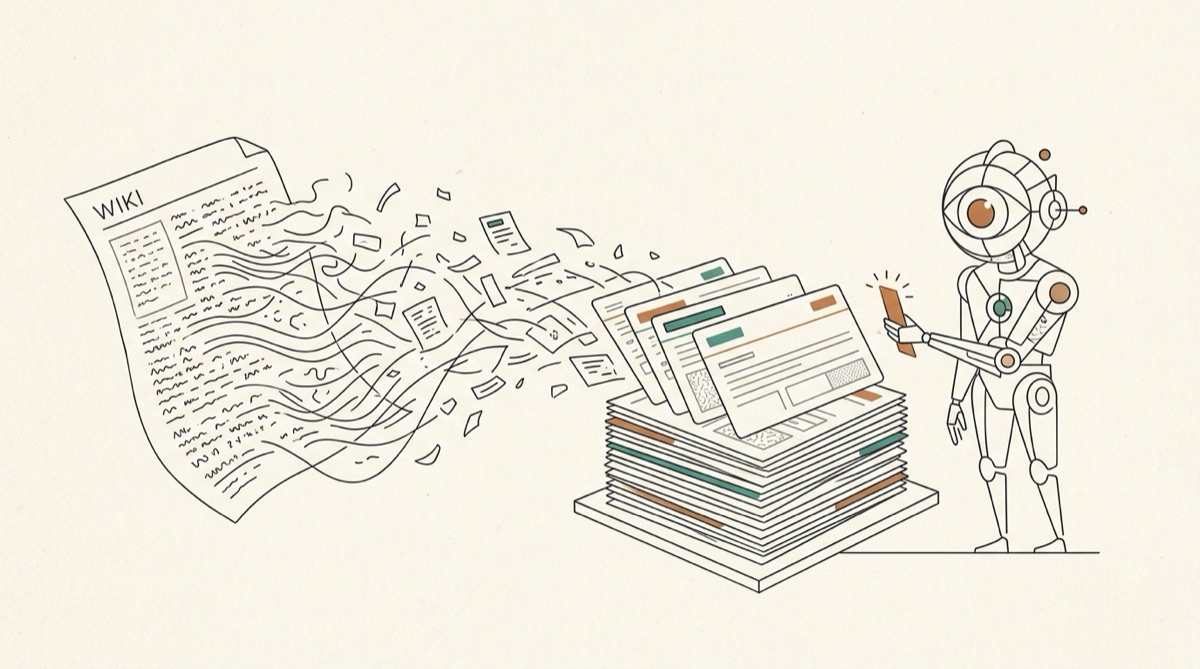
Search "AI knowledge base" today and you get a stack of complete-guide explainers that all describe the same thing: a searchable help center or wiki, with a chat box bolted on top so a human can ask a question in plain English instead of scrolling. That was the right definition three years ago. It's the wrong one now. In 2026 the thing reading your knowledge base most often isn't a person hunting for an answer — it's an agent that needs to produce work. The real question is no longer "can my team search the docs faster." It's whether your AI knowledge base serves clean, curated context to the agents doing the work.
That shift changes what "good" looks like. A knowledge base built for humans optimizes for browse-ability: nice categories, a tidy search index, articles a person can skim. A knowledge base built for agents optimizes for something else — density, correctness, and the ability to hand an agent exactly the right context at the moment it's drafting an email, analyzing a competitor, or writing a first draft. Most tools on page one still solve the first problem. Very few solve the second.
The buyer changed, so the definition has to
Here's the plain version of what's happening. You've adopted AI tools. Maybe you've documented your best prompts in a Notion doc. That's real progress, and it's also where most teams stall. The tools are commodities now — everyone has access to the same frontier models. What separates the output isn't the model. It's what the model knows about your business.
A prompt document tells an agent how to do a task: the format, the tone, the steps. It doesn't tell the agent what the task actually means — your brand voice, who your customers are, how you're different from the competitor down the street. Almost nobody has that second set systematized. And it's the second set that decides whether an agent's draft ships with a light edit or gets thrown out and rewritten from scratch.
This is why "you can pay for AI tools, but you can't buy better context" holds up. Context is the part that takes work. You can expense a seat for every AI product on the market and still get generic output, because none of them know the first thing about your business until you tell them — deliberately, in a form they can read. An AI knowledge base for company data is exactly that form: the place your agents read from before they act.
Search is table stakes. Curation is the job.
The tools ranking for this term lean hard on one feature: AI-assisted search. Ask a question, get an answer pulled from your documents. That's genuinely useful for a support team fielding tickets. But retrieval alone is not enough when the reader is an agent producing work at volume.
The reason is boring and important: there's simply too much data you could store, and most of it is noise. A retrieval-only system will happily surface a stale pricing page, a superseded positioning doc, and last year's brand guidelines all in the same breath, then let the agent average them into something plausible and wrong. The difference between a knowledge base and a company brain is active management — something curates both the index and the content itself. Otherwise it's just a knowledge base, and knowledge bases get stale.
Staleness isn't a maybe. It's the default. Every team says the same thing — "we have a Notion doc with our best prompts" — and every team hits the same curve: excited in month one, stale by month four. Nobody owns the pruning. The doc grows, contradicts itself, and quietly stops being trusted. This is why Notion and Confluence are where context goes to die for agents: they're built to accumulate pages, not to keep a living context layer honest.
The fix is to treat context like code. Version it. Review it on a schedule. Archive what's stale and promote what works. And here's the part that makes it tractable: the curation doesn't all have to be human. LLMs can help curate — flag contradictions, surface duplicates, suggest what to retire — as long as a person still owns the calls that matter. The point isn't to do it all by hand. It's that someone, or something, is actively managing the thing instead of hoping search papers over the rot.
Density beats volume
There's a natural instinct to make an AI knowledge base big — dump in every doc, every deck, every wiki page, and trust retrieval to find the good bits. It backfires. Context density beats context volume. Five sharp brand-voice examples beat fifty pages of guidelines. One great past email beats ten mediocre ones. When you feed an agent a curated handful of the right examples, its output tightens. When you feed it everything, it regresses to the mean.
This is the practical heart of an agentic knowledge base: not "more storage with a chat box," but a deliberately curated set of the things that actually define how your company works — voice, customers, positioning, the decisions you've already made — kept small enough to stay sharp and current enough to stay true. That's also what separates a real LLM knowledge base from a vector database with good marketing. Better retrieval over a swamp is still a swamp.
One shared brain, not a memory per agent
Once you accept the agent as the reader, a second design question shows up: where does the context live? The tempting answer is per-agent memory — let each agent remember its own stuff. It doesn't hold up. You spin up many agents for many different tasks; a memory trapped inside one of them is useless to the rest. What you want is one shared brain for the company that every agent reads from.
Get that right and every agent — the campaign-brief drafter, the competitor-analysis agent, the support responder — sounds like your company, whoever on the team set it running. Get it wrong and you rebuild the same institutional-knowledge silos AI was supposed to dissolve, except now they're scattered across a dozen bots instead of a dozen people's heads. The whole reason organizations spend so much effort on information transfer is that memory lives in separate places. A shared context layer is a chance to fix that, not re-create it.
Where this sits in your AI maturity
Most teams are stuck at Level 2–3 of AI maturity: tools adopted, prompts documented. Useful, but a plateau. The jump that matters is Level 4 — context infrastructure: business context captured once and reused everywhere, by every agent, on every surface. That's the difference between "we use AI" and "AI produces work that sounds like us by default."
An AI knowledge base built for that world has a few non-negotiables:
- Curated, not just searchable. Something actively manages the content — human, LLM-assisted, or both — so what agents read stays current and true.
- Dense, not exhaustive. The best examples, not every example. Small and sharp beats big and average.
- Shared, not siloed. One home every agent reads from, so output is consistent no matter who or what runs it.
- Readable by machines. Agents reach it over web, API, and MCP — the same brain, whichever door they come through.
Patina is built around exactly this. It's one shared context home — brand voice, customer personas, playbooks, and the decisions behind them — that your agents read from over web, API, and MCP. It's human-curated with a review workflow, so nothing lands in the brain your agents trust without someone signing off, and it's $79/mo self-serve, not an enterprise sales cycle. It's the second set of knowledge — the "what," not just the "how" — kept dense, current, and shared.
If you're evaluating options, it's worth reading how the agent-native approach compares to the human-wiki tools that dominate this category in our AI knowledge base alternatives breakdown, or just see pricing and start.
The short version
The page-one definition of "AI knowledge base" — a wiki humans search with an AI assistant — describes a solved problem for a shrinking use case. The version that matters in 2026 is the one your agents read from: curated, dense, shared, and machine-readable. Search is table stakes. Active management is the job. You can pay for the tools tomorrow. The context is the part that takes work — and it's the only part that's yours.