Knowledge Graph vs Vector Database: Curated Context Wins
Jul 18, 2026
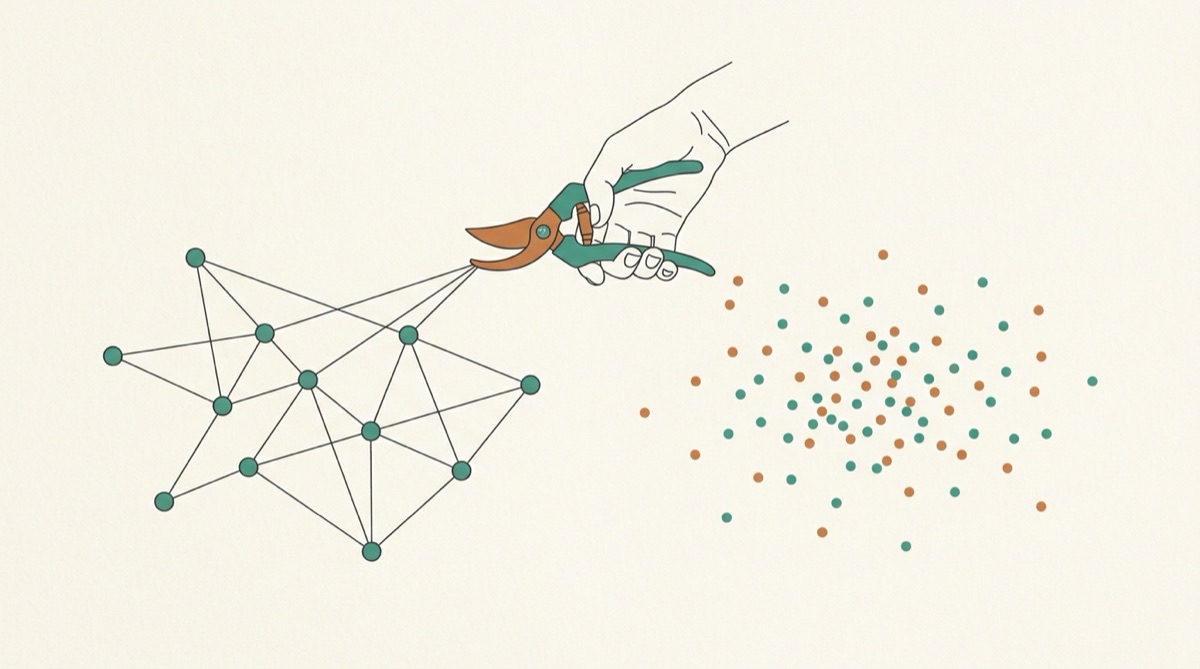
The knowledge graph vs vector database debate is usually framed as a backend pick: which retrieval engine should sit under your AI agents? It's a real engineering question with a real answer. But it's also the wrong place to start if you're an operator trying to get AI that sounds like your business. The retrieval index is the last mile. The thing that decides whether your agents are useful is what you put in front of it — and whether anyone is keeping that current. No index fixes context nobody curated.
This piece does two things. First, a fair, accurate summary of the graph-vs-vector debate as engineers have it. Then the reframe: why the index is rarely your bottleneck, and what actually moves the needle.
Knowledge graph vs vector database: the honest engineering comparison
Both are ways to store and retrieve information so an AI model can use it at generation time. They answer different questions well.
A vector database stores text as embeddings — numeric representations of meaning. When you ask a question, it finds the passages whose meaning sits closest to your query. This is the engine behind semantic search: matching on intent rather than exact keywords, so "how do we handle refunds" surfaces the returns policy even if it never uses the word "refund." Vector search is fast, cheap to stand up, and forgiving of messy, unstructured text. Its weakness is precision on relationships. It retrieves passages that look relevant; it doesn't reason over how facts connect.
A knowledge graph stores information as entities and the explicit relationships between them — this customer belongs to this account, which signed this contract, which is governed by this policy. When a question depends on those connections ("which enterprise accounts are affected by the pricing change we shipped in Q2"), a graph can traverse the links and return an exact, explainable answer. Its cost is upfront: someone has to model the entities, define the relationships, and keep the structure honest as the world changes.
Here's the fair summary of where each earns its keep:
| Vector database | Knowledge graph | |
|---|---|---|
| Stores | Embeddings (meaning as numbers) | Entities + explicit relationships |
| Best at | Semantic search over unstructured text | Multi-hop questions across connected facts |
| Setup cost | Low — point it at your docs | High — model the schema first |
| Handles messy text | Well | Poorly without structuring |
| Explainability | Weak (why did it match?) | Strong (traceable path) |
| Fails when | Question needs relationship reasoning | Content is unstructured and fast-changing |
In practice, serious RAG (retrieval-augmented generation) systems increasingly use both — vector search for broad recall, a graph for the queries that need precise structure. So the "vs" is a little manufactured. Most mature setups are hybrid. If you're the engineer building the pipeline, that's the real answer, and it's a good one.
Why the index is rarely the bottleneck
Now the operator reframe. If your AI agents produce generic, off-brand, or subtly wrong output, upgrading from vector to graph — or bolting on both — usually won't fix it. The failure is almost never that the retrieval engine couldn't find the right passage. It's that the right passage was never written, or it's three versions stale, or it's buried in 90% fluff that drowns the 10% that mattered.
Not all context is equally valuable, and no index changes that. High-density context — brand-voice examples, persona quotes in your customers' own words, a past email that actually performed — beats low-density context like a generic about-us page, a stale positioning doc, or meeting notes that are mostly noise. Feed either one to a vector store or a graph and the ranking might differ, but the ceiling is set by the content, not the retrieval math. Five sharp voice examples beat fifty pages of guidelines every time. The lever is density, not indexing.
This is why "just add retrieval" quietly disappoints so many teams. You can pay for a better index. You can't buy better context — that part takes work. Retrieval is a solved-enough problem; the embeddings are good, the databases are fast. What's unsolved on most teams is the business context that feeds AI agents in the first place: it lives in people's heads, in Slack threads, in the last edit someone made to a Google Doc. Putting it in the right place, in a form agents can actually use, is the whole game.
Curated context beats a better index
The real dividing line isn't graph versus vector. It's curated versus uncurated.
You need curated context, not just better retrieval. There's simply too much data you could store — dump all of it into any index and you've built a more efficient way to retrieve noise. Curation is the discipline of deciding what's worth keeping, keeping it current, and cutting what's gone stale. It's the difference between a knowledge base and something that stays useful. A knowledge base you point at your docs and forget — the way most LLM knowledge bases get built — just gets stale. A maintained one curates both the index and the content itself — otherwise it's just a knowledge base, and knowledge bases go stale by default.
Curation doesn't all have to be human. LLMs can help — flagging duplicates, suggesting what to archive, drafting summaries, spotting contradictions. That's fine and it scales. What isn't fine is relying on search and retrieval alone. Retrieval-only assumes the answer is already in there and well-formed; curation is how it gets to be well-formed. The best setups treat context like code: version it, review it monthly, archive what's stale, promote what works. An index is a snapshot. Curation is the upkeep that keeps the snapshot worth taking.
This is also where the single-agent-drowning-in-everything model breaks down. Multi-agent beats monolithic: each agent gets a focused, relevant context window instead of one agent trying to reason over everything you know. Which agent needs which context — the campaign drafter needs brand voice, the competitor-analysis agent needs positioning — is a curation decision, not a retrieval one. Context selection matters more than prompt phrasing. You can rewrite the prompt all day; if the agent is looking at the wrong slice of your knowledge, better wording won't save it.
What this means if you're choosing a stack
If you're an engineer, the graph-vs-vector question is legitimate and the answer is often "hybrid, and it depends on your query shape." Model the relationships you'll actually traverse; use vectors for the fuzzy recall. Don't over-engineer a graph for content that's mostly unstructured prose, and don't expect vectors to reason over connections they can't see.
But if you're the operator deciding whether AI is worth the spend, resist getting pulled into the backend debate. The questions that predict whether your agents will be good aren't about the index:
- Is the high-value context even written down? Your voice, your ICP in your customers' words, your real positioning, what got edited last time and why.
- Is it dense, or is it fluff? Examples over rules. One great artifact over ten mediocre ones.
- Is someone keeping it current? Or does it go stale by month four, like every "we have a Notion doc of our best prompts" story ends.
- Is it one shared home, or scattered? So every agent, run by anyone, reads from the same curated context.
Those four questions are what an agentic knowledge base has to answer — and none of them are settled by graph versus vector. This is the case for treating context as its own layer, maintained on purpose rather than assembled at query time.
Where Patina fits
Patina is built on that reframe. It's a company brain: one curated home for the context your agents read from — brand voice, personas, playbooks, and the decisions behind them — served over the web, an API, and MCP, so every agent on every surface reads from the same reviewed, current context. The point isn't a cleverer retrieval index. It's active management: human review on what matters, LLM assistance on the busywork, and a workflow that keeps the content current instead of letting it rot. Curated context, kept fresh, so the output sounds like your company whoever ran the agent.
The graph-vs-vector question will keep getting asked, and it's worth answering well at the infrastructure layer. Just don't mistake it for the thing that makes your AI good. The model is commoditizing. The index is nearly commoditized too. What's left — the part that's actually hard, actually yours, and actually decides the output — is the context, and whether anyone is curating it.