Business Context for AI Agents: The Part Everyone Skips
Jul 18, 2026
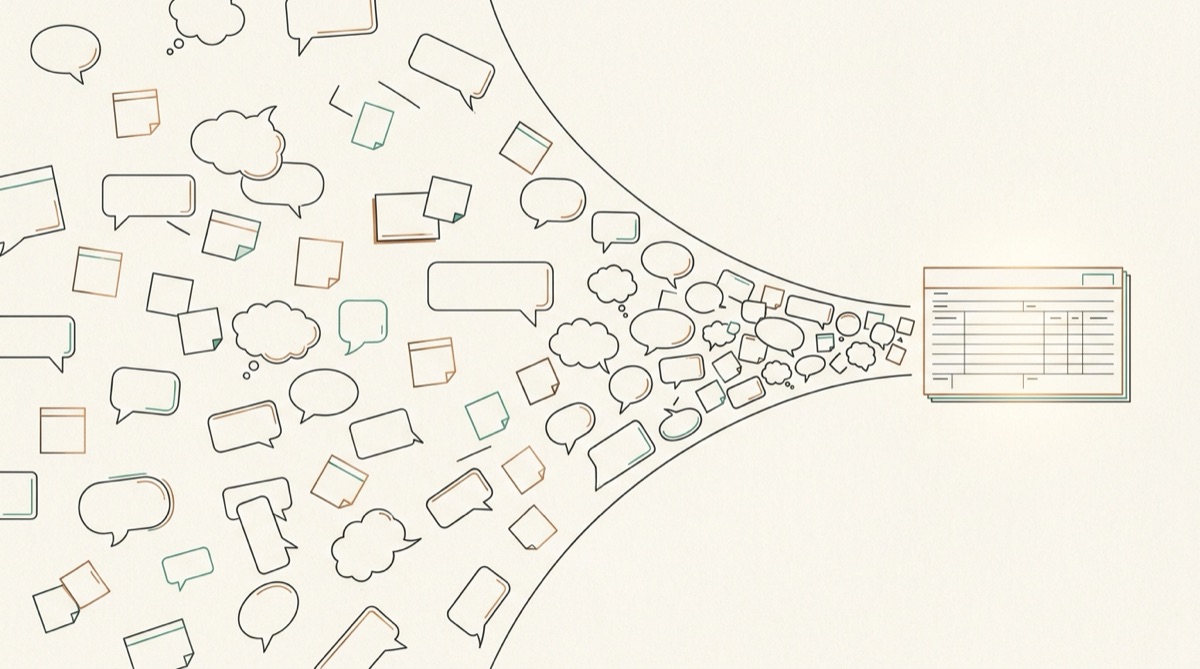
Ask ten vendors what "business context for AI agents" means and you'll get ten versions of the same answer: connect your agents to your data warehouse, govern the pipelines, give the model access to the system of record. That's the CIO's version of the problem. It's real, but it's not the version that's costing your marketing and ops teams every day. The context your agents are actually starved for isn't in a database. It's in people's heads, in Slack threads, in the last edit someone made on a Google Doc — the human-authored stuff about how your business works that nobody ever wrote down for a machine to read.
That gap is the whole game. Putting that context in the right place is the difference between an agent that sounds like your company and one that sounds like the internet average.
What the incumbents get wrong about business context for AI agents
Read the analyst pieces and the data-platform blogs and you'll notice they all frame context the same way: as a governance and infrastructure problem. Catalog the data. Wire up retrieval. Enforce access controls. Give the agent a bigger, cleaner pile of records to search.
None of that is wrong. But it quietly assumes the useful context already exists somewhere structured, and the only job left is plumbing. For an operator, that assumption is backwards. The reason your campaign-brief agent produces flat, generic copy isn't that it can't reach your CRM. It's that nobody has ever told it your voice, your positioning, or which three customer objections you actually get. That context was never in a system to begin with. It lived in the head of the one person on the team who's good at prompting, and it left the building when they logged off.
So when a team chases "better context" by buying a bigger model or a fancier retrieval index, they're solving the plumbing while the reservoir stays empty. "You have an AI budget, not an AI strategy." The bottleneck was never access to data. It was that the human knowledge agents need was never captured in a form they could use.
The context that lives in people's heads
Here's the part the data-governance framing skips entirely. Most of what makes your team's output good is tacit. It's the stuff a new hire absorbs over their first three months by osmosis — not from a document, but from watching, correcting, and being corrected.
Break it down and it's surprisingly concrete:
- Voice — not "be professional," but five examples of your best content and the instruction to write like that.
- Personas — your ideal customer described in the words your best customers actually use, not a marketing-deck caricature.
- Process — the playbooks your strongest people run, so the throughput work doesn't route through one person forever.
- Decisions — what you decided, why, and what's changed since.
Notice how little of that is a "data" problem. A brand guide is a document. What you need is a context layer — something agents read from every time they run, not a PDF a human skims once and internalizes. Brand guides were written for humans who would read them once and internalize. AI arrives with no memory of the last time.
And the most useful part of that context is usually the part nobody writes down. Most brand guides list what you sound like. The more useful list is what you don't sound like. Left to its own defaults, an agent regresses to the internet average — competent, generic, forgettable. Your brand actually lives in the exceptions: the phrases you'd never use, the claims you refuse to make, the tone you deliberately avoid. Capturing those exceptions does more for output quality than another page of positive guidelines ever will.
Managing context means managing decisions, not just documents
The clearest example of why "context" is a human problem, not a data problem, comes from decisions — and it's the failure mode almost nobody designs for.
Run product-development agents that pull strategy docs and past decisions before they answer a strategy question, and you'll hit this fast. Say you make a decision a few weeks ago. This week, you reverse it. If nobody goes back and marks the old decision as superseded, both versions are now sitting in your context, equally retrievable, equally confident. One agent run picks up the new decision. The next run picks up the old one. Same question, same agent, two contradictory answers — and neither is obviously wrong on its face.
"It's just not consistent."
That inconsistency isn't a model failure. It isn't a retrieval failure either — retrieval did exactly what it was told, surfacing a relevant document. The failure is upstream, in curation. Nobody managed the state of the knowledge. This is the thing a data catalog and a bigger context window can't fix for you: an agent has no way to know that a decision from three weeks ago was quietly overturned unless a human recorded that it was. Managing context, it turns out, means managing decisions — not just piling up documents and hoping retrieval sorts it out.
That's also the line between a static knowledge base and something worth trusting. A pile of documents just gets stale. What keeps context useful is active curation: someone — or an LLM helping someone — marking what's current, archiving what's dead, and promoting what works. Treat it like code: version it, review it, retire the superseded. Retrieval alone, over an unmanaged pile, will happily hand your agents last month's reversed decision with a straight face.
It's not just voice — ops teams need the facts
It's easy to hear "business context" and think it's only a brand-voice concern. It isn't. Marketing teams want consistent content, sure. But ops teams want agents that know the facts: the current state of a customer, this quarter's metrics, which accounts are at risk. That's every bit as much the use case as tone of voice, and it has the same failure mode — an agent working from stale or contradictory facts produces confident garbage, whoever runs it.
This is the shift from prompt engineering to context engineering. The prompt tells the agent how to do the task. The context tells it what the task actually means for your business — who the customer is, what you decided last week, what's true today. Almost nobody has that second set systematized, which is exactly why the same agent on the same task produces wildly different output depending on who's driving it and what they happened to paste into the window.
How to give AI agents company knowledge they can use
The fix is less exciting than a new model and far more durable: capture the business context once, in a place every agent reads from, and keep it curated.
Practically, that means one company memory for voice, personas, process, and decisions — served to agents however they show up, over web, API, or MCP — with a human review step so what lands is deliberate, not accidental. When you give AI agents company knowledge this way, a new agent is productive on its first run the same way a new hire is productive on day one when the workspace already has the brand voice and the playbooks waiting.
The loop that keeps it alive is simple. When an agent produces something off-brand or just wrong, correct it in the moment — then ask the agent itself to save that correction back to the shared context and update what it knows. The fix stops being a one-off you'll repeat next week and becomes shared knowledge every future run inherits. Do that consistently and consistency stops being luck — it becomes a property of the system, not a trait of whoever's driving.
This is the bet behind Patina: one curated home for the human-authored context your agents need — voice, personas, playbooks, and the decisions that are actually current — so every agent, whoever runs it, sounds and reasons like your company did. The model was never the differentiator; what your agents know about your business is. The incumbents will keep selling you plumbing. The context that makes the output yours was never in the pipes.