Context Engineering vs Prompt Engineering for Teams
Jul 18, 2026
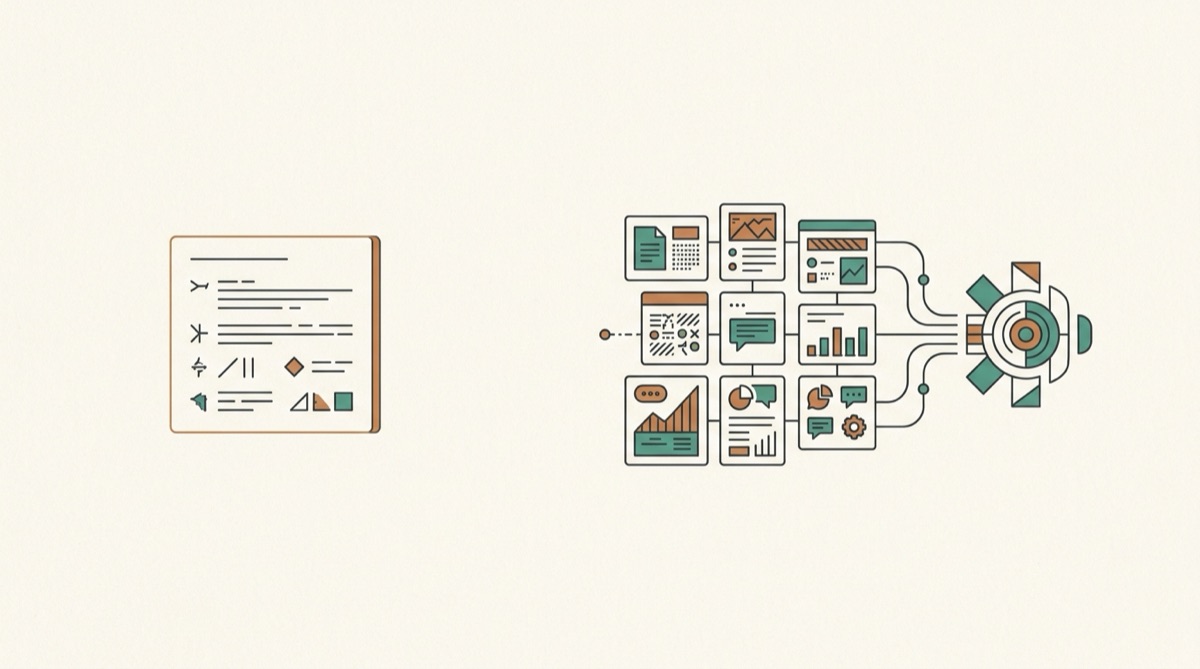
If you run a marketing or ops team, the debate over context engineering vs prompt engineering can read like a conversation happening in a different building. The lab explainers frame it for people building models and agent frameworks: how to pack a context window, how to manage tokens, how to structure retrieval. All useful. None of it tells you what to actually do on Monday when your agents keep producing content that sounds like everyone else's.
So here's the operator version. Prompt engineering is the craft of writing the instruction — the task, the format, the tone. Context engineering is the craft of deciding what the agent knows before it reads that instruction — your brand voice, your customers, your positioning, the decisions you've already made. The first is how to do the task. The second is what the task actually means for your business. Most teams have gotten decent at the first and never systematized the second.
Context engineering vs prompt engineering, in one refactoring story
The cleanest way to feel the gap is a small failure. "I gave an agent 'refactor the authentication module' and got the wrong architecture — I hadn't given it our constraints or past decisions. Same agent, same task, second time with our engineering context loaded first: correct architecture. The model wasn't the bottleneck. The context was."
Nothing about the prompt changed. The instruction was fine both times. What changed was whether the agent had the constraints, the prior decisions, the things a senior person on the team would have known without being told. That's the whole argument in miniature. Your agents don't need a better model. They need better context. Teams chase frontier-model access while their agents produce generic output because they don't know the first thing about the business.
Swap "refactor the authentication module" for "draft the Q3 campaign brief" or "summarize where this account stands" and the shape is identical — the same lesson runs through every one of these AI agent examples. A capable model with no company context writes something plausible and wrong. The same model with your voice, your personas, and your last three decisions loaded writes something you can ship with light edits.
Is context engineering actually new?
Worth being honest here, because the term gets oversold. Context engineering is genuinely new for most engineers — and for most marketing and ops people it's brand new. But it isn't new to everyone. Data engineers have spent years wrestling data into the right place at the right time so the right system can use it. That's the same job, wearing new clothes. The task, stripped of jargon: get the right context to the right agent at the right time. At least where the technology sits today, that's most of the work.
Which is oddly reassuring. This isn't a mysterious new AI discipline you have to invent from scratch. It's an old operations problem — getting what your best people know into a form the rest of the team (now including the agents) can use — showing up again with a new category of work.
Static prompts, dynamic context
The most practical rule that falls out of all this: static prompts, dynamic context. Your system prompt — "you are a helpful assistant that writes marketing copy" — barely changes. It's stable. What changes on every single task is the context: which campaign, which segment, which product, what got edited last time and why. So don't hard-code business knowledge into prompts.
This is where a lot of teams quietly go wrong. They discover that adding "our brand is warm but not cutesy, we serve mid-market ops leaders, we never say 'revolutionize'" makes the output better, so they paste that into the prompt. It works. Then it lives in one person's prompt, in one tool, and every other agent and teammate starts from zero again. The knowledge got captured in exactly the place that can't share it. Prompts are how you drive a task. They're a bad filing cabinet for what your company knows. For more on where that knowledge should live instead, see our guide on what a context layer for AI actually is.
The better instinct is to treat context like an asset: written once, versioned, reviewed, and reused across every agent and every person on the team. A prompt and a playbook are not the same thing — the prompt is disposable, the context behind it is the compounding part.
What "context" actually means for a marketing or ops team
The lab articles keep "context" abstract on purpose — they're writing for a general audience. For you it's concrete, and it's a short list:
- Brand voice — ideally shown, not described. Five examples of your best content beat fifty pages of guidelines. And the more useful half is what you don't sound like, because AI defaults to the internet average and your exceptions are where the brand actually lives.
- Personas — your ICP in the words your best customers actually use, not the sanitized version from the deck.
- Playbooks — the workflows your strongest operator figured out, written down so anyone can run them.
- Decisions — and this is the one almost everyone forgets.
That last one deserves its own beat, because it's where marketing teams and ops teams start to diverge. Marketing wants consistent content. Ops wants agents that know the facts — the state of a customer, the current numbers, what was decided last week. Context engineering isn't only about making agents sound the same. It's about making them know the same things.
The decision problem nobody warns you about
Here's the failure that bites operations teams specifically. You make a decision a few weeks ago. This week you reverse it. If nobody marks the old decision as superseded, your agents get confused — one run picks up the new decision, another run picks up the old one, and the output is contradictory across the week. It's just not consistent.
Managing context, it turns out, means managing decisions, not just documents. A stale doc is annoying. A live-but-wrong decision floating next to its replacement is worse, because both look authoritative. This is exactly the kind of thing prompt engineering can't touch — no amount of instruction-tuning fixes an agent that's reading a decision you already reversed. The fix is upstream, in the context itself: mark what's superseded, keep the current answer current. This is a big part of what business context for AI agents has to cover once you get past the demo stage.
Retrieval isn't enough — curation is the job
The tempting shortcut is to dump everything into a search index and let retrieval sort it out. It doesn't hold up. There's simply too much you could store, and most of it is low-density — generic about-us pages, stale positioning, meeting notes that are 90% fluff. You need curated context, not just better retrieval. LLMs can help with the curating; relying on search and retrieval alone is not good enough. Without active management, a knowledge base just gets stale — and a stale context store is a slow version of the same generic-output problem you started with.
That's the operational core of context engineering, and it's the part the abstract explainers skip. It's ongoing work: capture the context, review it, archive what's dead, promote what works, keep decisions current. This is the job Patina is built to do — one shared home for brand voice, personas, playbooks, and decisions, a company memory that's curated rather than just filled, kept current through a real review workflow and read by every agent over web, API, and MCP, so whoever runs the agent, the output sounds like your company and knows your facts. When an agent gets something wrong, you correct it once and save the correction back, so the fix becomes shared context instead of a lesson one person learned.
The bottom line
Prompt engineering makes a single task come out better. Context engineering changes what your whole team of agents is capable of — because it's the difference between speeding up the typing and speeding up the thinking. "Speed up the typing and you get a faster team. Speed up the thinking and you get a different team entirely."
If your agents are producing generic work, resist the urge to go shopping for a smarter model or a cleverer prompt. Look at what they know about your business first. That's almost always where the bottleneck actually is.