AI Playbook vs Prompt: What's the Difference?
Mar 18, 2026
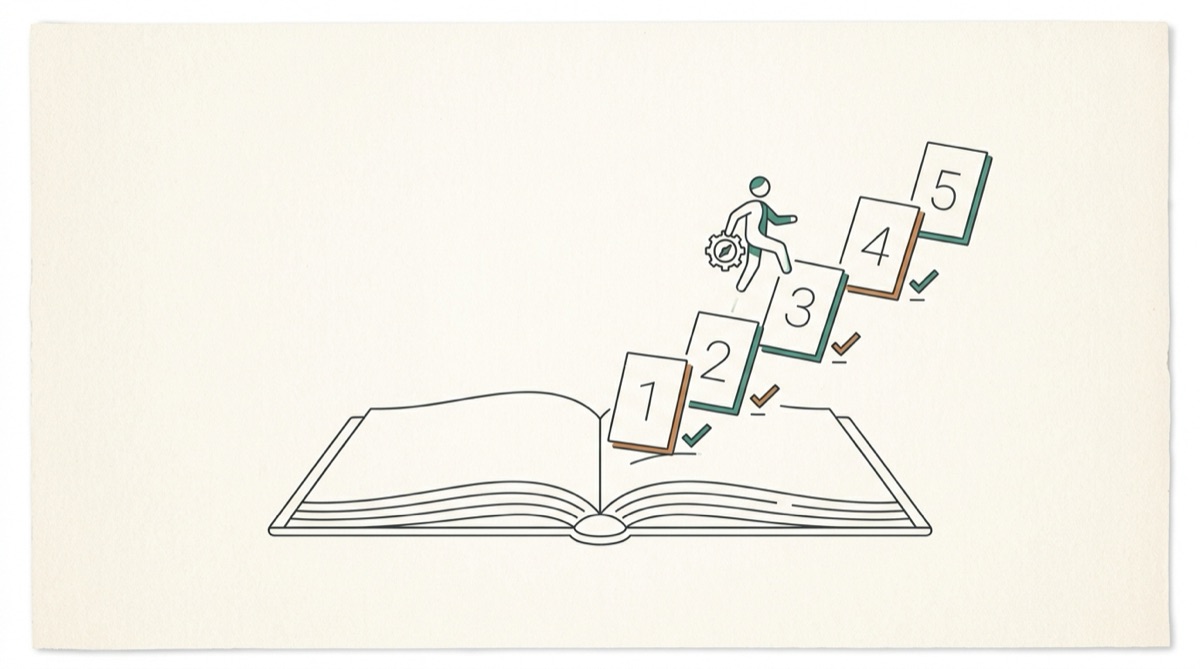
A prompt is a single instruction you type into an AI tool. A playbook combines that instruction with business context, defined inputs, examples, and team approval — making it reusable and consistent across people, not just effective for the person who wrote it.
What is an AI prompt?
A prompt is the text you type — or paste — into an AI tool to get it to do something. It might be one sentence or several paragraphs. It might include instructions, background, and an example. But at its core, a prompt is an ad-hoc instruction that exists in a single conversation at a single moment in time. Prompts have real strengths. They are fast to write, easy to iterate, and flexible enough to handle almost any task. The best prompts are specific: they tell the model exactly what you want, in what format, and at what level of quality. A well-crafted prompt in the hands of a skilled AI user produces consistently impressive output. The limitations are structural. A prompt is personal. It exists in your session, your browser tab, your ChatGPT history. It captures what you want right now — not the accumulated knowledge of what your team knows about how to do this task well. According to McKinsey, 30–40% of AI-assisted workflows in knowledge-work teams are undocumented, meaning the people who wrote those prompts are the only ones who can reliably reproduce those results. Three failure modes follow from this:
- Fragility. Prompts that work brilliantly for their author often fail for a colleague running the same task. The author brings implicit knowledge — about tone, audience, constraints, and what "done" looks like — that the prompt doesn't capture.
- No reuse path. Even when a prompt is shared in Slack or a Google Doc, there is no structure for versioning it, marking it approved, or attaching the context that makes it work. The sharing is passive — it's readable, not reusable.
- Not agent-ready. As teams move toward AI agents that execute tasks autonomously, prompts stored in chat histories and documents cannot be accessed programmatically. They exist in a form useful only to humans copying and pasting.
What is an AI playbook?
A playbook starts with a prompt — but it doesn't stop there. It bundles the prompt with everything that makes the prompt work reliably when someone else runs it: structured inputs, attached context, defined output criteria, and a trust state that tells the team whether this workflow has been reviewed and approved. The components that distinguish a playbook from a prompt:
- Structured inputs. Instead of implicit assumptions about what the user will supply, a playbook defines the inputs explicitly — what they are, what format they should take, and what happens if they're missing. This is the difference between
[AUDIENCE]in a prompt and "Audience: the seniority level of the reader (e.g. 'senior manager with no technical background')" in a playbook. - Attached context. The business knowledge that makes AI output team-quality lives outside the prompt. Brand voice. Customer definitions. Regulatory constraints. Quality benchmarks. A playbook attaches this context explicitly rather than leaving it to the individual running the task to know or guess.
- Versioning. Playbooks are iterated, not finished. When a team discovers a better instruction pattern or needs to update a constraint, the change is tracked. The team always knows which version is current, what changed, and why — and can roll back if an edit breaks something.
- Trust states. A playbook a colleague wrote yesterday is different from one the team has tested, refined, and approved for production use. Playbooks carry an explicit status — draft, in-review, approved — that tells every team member whether this is a personal experiment or a vetted team asset.
- Agent-readiness. Because a playbook is a structured, versioned object in a registry, it can be pulled by an AI agent and executed reliably. The agent doesn't have to infer the context — it's already there. This is the architecture that makes autonomous AI workflows dependable rather than brittle. To make this concrete: imagine a task like "write a follow-up email to a sales prospect who asked for pricing." As a prompt, this might be: "Write a warm, professional follow-up email to a sales prospect who requested our pricing. Keep it under 150 words." That produces a reasonable generic email. As a playbook, the same task includes the prompt above, plus: your ICP definition, the prospect's industry context as a required input, your company's pricing philosophy, your tone guide, three examples of emails your team has sent that booked meetings, and an approved status set by your head of sales. The output is something a rep can send with minor edits rather than substantial rewrites.
Side-by-side comparison
The table below maps the six dimensions where prompts and playbooks diverge most. Note that "better" is not always the right frame — for a one-off personal task, the overhead of a playbook is unnecessary. The question is fitness for purpose.
| Dimension | Prompt | Playbook |
|---|---|---|
| Scope | Single instruction for one session | Bundled workflow with context and inputs |
| Reusability | Personal — works best for the author | Team asset — designed for consistent reuse |
| Context | Implicit — carried by the individual | Explicit — attached and structured |
| Versioning | None — edited in place or lost | Full history — changes tracked, rollback possible |
| Team trust | Unknown — no approval signal | Visible — draft, in-review, or approved |
| Agent-readiness | No — not machine-accessible | Yes — structured and retrievable by agents |
| The dimensions that matter most depend on what you're trying to do. For a single personal task, scope and reusability are irrelevant — a prompt is exactly right. For a workflow that multiple people run regularly, team trust and context become critical. For autonomous AI execution, agent-readiness is non-negotiable. |
When a prompt is enough — and when you need a playbook
Not every AI task needs a playbook. The decision framework is simple: if only you will run this task, and you'll run it infrequently, a prompt is sufficient. If the task is repeated, involves multiple people, or will eventually need to run autonomously, a playbook is the right tool. Use a prompt when: you're exploring something new and don't yet know what good output looks like. You're working alone on a one-off task. You're iterating quickly and the structure of a playbook would slow you down. You don't need anyone else to reproduce what you did. Build a playbook when: more than one person needs to run the same task. Output quality varies between team members doing nominally the same work. You want to onboard a new hire to a repeatable workflow without explaining everything verbally. You're planning to have an AI agent execute this task on your behalf. There are three clear signals that a team has outgrown prompts and needs playbooks:
- Multiple people doing the same task differently. If your content team each has their own version of "the blog post prompt," you have inconsistency at scale. A Deloitte survey found that 78% of knowledge workers use AI without standardised guidelines — the gap between the best and worst AI output in those teams is wide.
- Output quality varies by person, not by task. When a senior team member produces AI output that needs light editing and a junior team member produces output that needs heavy rewrites — using the same underlying prompt — the gap is almost always missing context, not missing skill. The senior person is supplying that context from memory. The junior person doesn't have it yet.
- New hires can't produce team-quality work from shared prompts. If you have to explain the prompt to someone before they can use it effectively, the explanation is the missing part of the playbook. What you explain verbally is exactly what needs to be written down and attached. Research from Boston Consulting Group found that AI-assisted workers outperform non-AI peers by 40% on average for knowledge tasks — but the variance is enormous. High-performing AI users outperform low-performing ones by a factor of three on the same tasks. The difference is overwhelmingly the quality of the context they give the model. Playbooks are how teams close that variance gap. In Patina, playbooks live in a shared brain alongside the context they depend on — the voice guide, the personas, the decisions — where your team and every agent read the same approved version. Edits, whether from a teammate or an agent, arrive as proposals through a review loop: the trust states in the table above are real gates, not labels.
Frequently asked questions
Can I turn my existing prompts into playbooks?
Yes. The process is straightforward: take a prompt that already works well, then add what it implicitly depends on — the audience, the tone, the inputs someone needs to fill in, and an example of good output. That surrounding information is what turns a personal prompt into something a colleague can run without asking you for help. Most teams find they have 5–10 prompts worth converting immediately.
Are playbooks only for teams?
No — solo users benefit from playbooks too. If you run the same type of task repeatedly (writing client proposals, summarising research, generating reports), a playbook saves you from reinventing the setup each time. The benefits compound when others join your workflow, but the baseline value is personal consistency and speed.
Do playbooks work with ChatGPT, Claude, and other AI tools?
Yes. A playbook is model-agnostic — it is structured text you can use with any AI tool. You can paste a playbook into ChatGPT, Claude, Gemini, or any other model. Some playbook registries offer direct integrations with specific providers, but the content itself is portable. This is one advantage playbooks have over tool-specific features like GPTs or Projects: they travel with you.
How are playbooks different from prompt templates?
A prompt template is a prompt with blank fields you fill in. A playbook is a template plus the surrounding knowledge that makes it work: what context the AI needs, what good output looks like, who has approved it for team use, and which version is current. The template tells you what to type. The playbook tells you — and the AI — everything else.
Do I need to be technical to create a playbook?
No. If you can describe how you do a task well — the inputs you gather, the context you bring, the standard you hold your output to — you can write a playbook. The skill is articulating what you already know implicitly. In a shared-brain tool like Patina, a playbook is a living document your whole team can read and propose changes to — no technical knowledge required.