How to Build an LLM Knowledge Base Agents Will Read
Jul 18, 2026
Building an LLM knowledge base is easy for a weekend. Dump your docs into a vector store, wire up retrieval, and your agents can suddenly "search everything." Then month four arrives, half the content is stale, nobody trusts the answers, and the whole thing quietly rots. The build was never the hard part. Keeping a knowledge base your agents will actually read — and get correct answers from — is the part almost nobody plans for. This guide is about that part: how to curate, structure, and maintain an LLM knowledge base so it stays useful past the first flush of enthusiasm.
Why most LLM knowledge bases go stale
Here's a line you've probably said, or heard: "We have a Notion doc with our best prompts." Every team says it. And every team hits the same failure curve — excited in month one, stale by month four. The doc grows, nobody prunes it, contradictions pile up, and eventually people stop trusting it enough to read it. The agents inherit that distrust, because they're reading the same rot.
The DIY playbooks that rank for this topic — the GitHub gists, the "build your own LLM wiki" write-ups — are genuinely useful for standing something up. But they optimize for the build and go quiet on the maintenance. That's the gap. A knowledge base is not a project you finish; it's a thing you keep. The difference between a knowledge base and a company brain is active management: something curates both the index and the content itself. Otherwise it's just a knowledge base — and knowledge bases just get stale.
Curation beats dumping docs into a vector store
The default modern approach is: embed everything into a vector store, retrieve on demand, let the model sort it out. It feels sophisticated. It mostly isn't enough. There's simply too much data you could store, and retrieval quality degrades as the pile grows. You end up with an agent that surfaces a plausible-looking passage from a doc that was superseded six weeks ago and states it with total confidence.
What you actually need is curated context, not just better retrieval. That means someone (or something) is deciding what belongs, what's canonical, and what's been replaced. Curation doesn't all have to be human — LLMs are good at helping curate: deduplicating, flagging contradictions, drafting summaries. But relying on search and retrieval alone, with no active management on top, is not good enough for a team that's betting its output on the answers.
A concrete example of why this matters: superseded decisions. Say you make a call one week and reverse it the next. If nobody marks the old decision as superseded, your agents get confused — one run picks up the new decision, another picks up the old one. The output stops being consistent, and consistency is the entire reason you built the knowledge base. Managing context means managing decisions, not just documents. A vector store won't do that for you. Curation will.
Context density beats context volume
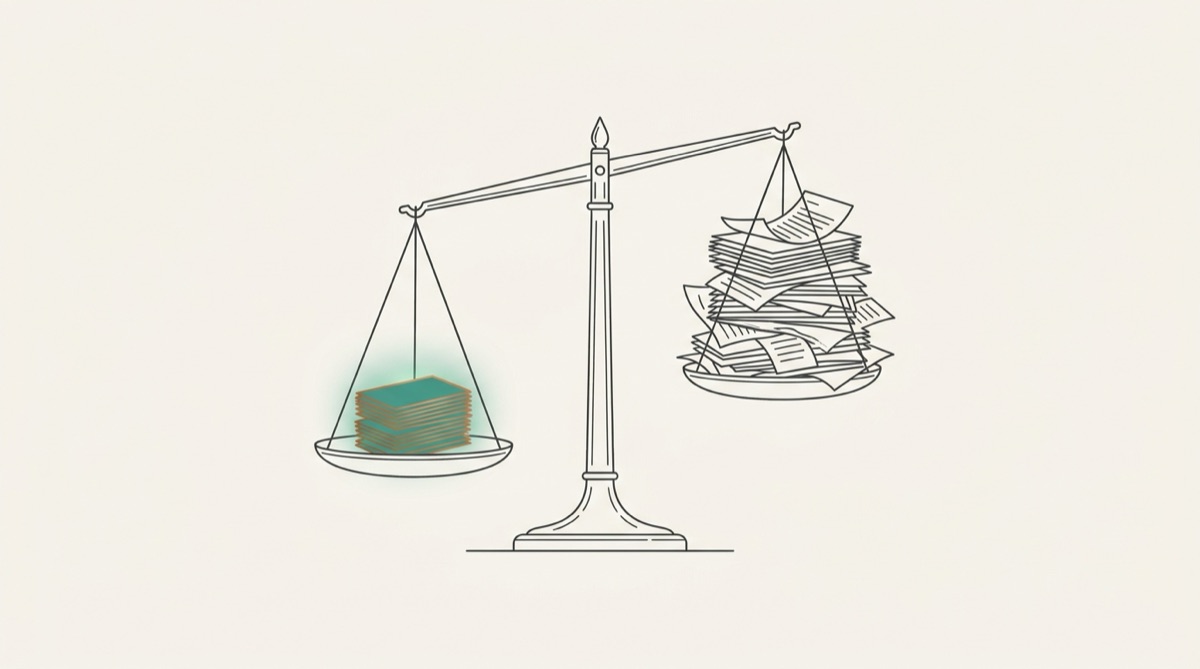
The instinct when building an LLM knowledge base is to add more: more docs, more pages, more coverage. Resist it. Context density beats context volume. Five well-chosen brand-voice examples beat fifty pages of guidelines. The model doesn't need a library; it needs the right signal at the right moment.
This is why "we uploaded our whole wiki" is not a strategy. Most of a wiki is noise for any given task, and every irrelevant page you retrieve is a chance for the agent to anchor on the wrong thing. When you're deciding what goes into the knowledge base, the useful question isn't "is this true?" — it's "is this the densest version of this truth?" A short, sharp example that shows the model exactly what good looks like will outperform a long policy document describing it in the abstract.
The same logic applies to how you write the content. If you're capturing brand voice, the thing that works best is a well-written voice guide with a handful of real examples and a few rules — not rules alone, not examples alone. And you don't need to invent a machine-readable format for it. Write for humans. The AI will understand it, because models are trained on human text; the overlap is the point.
Structure it so agents can find the right thing
Density gets you good content. Structure gets your agents to the right content at the right time. This is the job that separates a usable knowledge base from a searchable pile: getting the right context to the agent at the moment it's working, which — at least where the technology is today — is most of the game.
A few structural habits that pay off:
- Separate the "how" from the "what." Prompt libraries capture the how of a task: instructions, format, tone. They completely miss the what: your business context, institutional memory, domain knowledge. Agents need the second set, and it deserves its own home rather than being smuggled into prompt templates — the shift from prompt to context engineering. (If prompts are where you're starting, our guide on how to share AI prompts with your team is a good companion.)
- Give each thing one canonical location. When the same fact lives in three docs, all three drift, and the agent gets to pick the wrong one. One source per fact.
- Mark state explicitly. Current vs. superseded, draft vs. approved. Agents can't infer freshness from vibes; they read what's there.
- Point to the readable, not the exhaustive. Structure your index so the densest, most-trusted content is what surfaces first.
If you want to go deeper on structuring knowledge specifically for agents to act on rather than just read, we cover that in agentic knowledge base.
Maintain it like code
The single mindset shift that keeps a knowledge base alive: treat context like code. Version it. Review it monthly. Archive what's stale. Promote what works. Code earned version control, processes earned documentation, design earned design systems — AI context is the thing we haven't systematized yet, and it needs the same discipline.
Practically, that looks like a standing rhythm rather than a one-time build:
- A monthly review pass where someone (or an agent, prompted to do it) checks what's gone stale, what contradicts what, and what should be archived.
- A promotion path: when a piece of context reliably produces good output, mark it canonical so it's the thing agents reach for.
- A correction loop for the day-to-day. When an agent produces something off-brand or wrong, correct it in the moment — then have the agent itself save the correction back to the knowledge base. The fix becomes shared context instead of a one-off you'll re-explain next week.
That correction loop is where a maintained knowledge base compounds. Every mistake you catch makes the next answer better, for everyone, not just the person who caught it.
Give AI agents company knowledge, not just prompts
Step back and the point of all this is simple: you're trying to give AI agents company knowledge — the same context you'd give a new hire on their first day. A prompt tells an agent how to do a task. It doesn't tell the agent what the task means: your customers, your positioning, how you're different, what got edited last time and why. Almost nobody has that second set systematized, and it's exactly what a real LLM knowledge base is for.
And it isn't only about making agents sound on-brand. Marketing teams want consistent content; ops teams want agents that know the facts — the state of a customer, the current metrics, the decision that got reversed on Tuesday. Voice and facts are both the use case. A knowledge base that only holds tone guidance is missing half the job.
One shared source beats per-person wikis
The last structural decision is the biggest: one shared knowledge base, not a scatter of personal ones. When every person keeps their own doc of prompts and context, you rebuild the exact problem you were trying to solve — the good stuff lives in one person's head or one person's Notion, and when they leave, the team is back where it started. One shared brain for the company means anyone's agents draw from the same well, and the whole team gets more consistent as the source improves.
You can serve that one source through more than one door. An MCP server for company knowledge lets agents on surfaces like Claude discover and read your context without any glue code; a CLI or API suits agents running in your own tooling. The interface matters less than the principle: many agents, one curated source, actively maintained.
This is where a tool like Patina fits — a shared context home for AI-native teams, human-curated with a review workflow, served over web, API, and MCP for $79/mo. But the tool is downstream of the discipline. Whether you build it yourself from the gists on page one or buy something that handles the curation and serving for you, the thing that makes an LLM knowledge base worth having is the same: dense content, clear structure, and someone keeping it honest. The tool isn't what makes the output sound like you — what your agents know is, and whether that knowledge stays true.