AI Agent Memory Is Backwards: One Shared Memory Wins
Jul 18, 2026
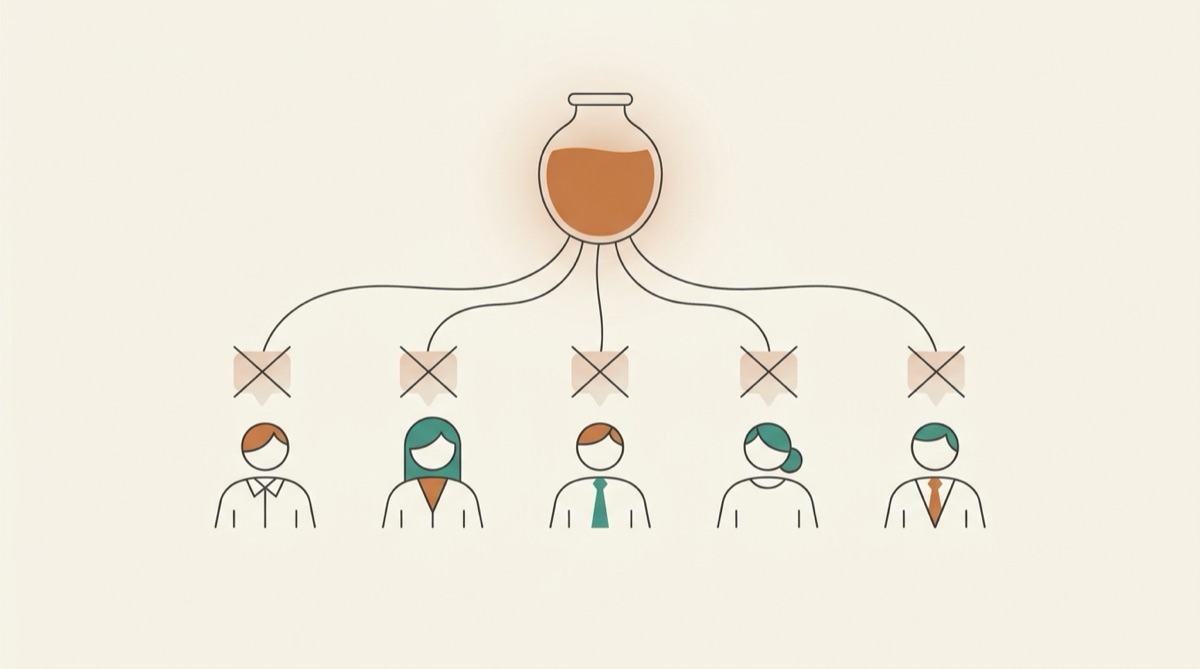
Most guides on AI agent memory are solving the wrong problem. They treat memory as something each agent carries — a per-agent runtime store that remembers a conversation, caches a few facts, and gets wired up framework by framework. That model is backwards. If you're running a business on agents, you don't want ten memories. You want one. Business memory shouldn't live inside each agent. It should live in a context layer every agent reads from.
This matters because per-agent memory doesn't even do the job you actually have. You don't run one agent. You spin up many — a campaign drafter, a competitor tracker, an ops assistant that answers questions about a customer's current state. Each one gets its own little memory that starts near zero and drifts in its own direction. Nothing your best agent learned on Monday reaches the agent you spin up on Thursday. The knowledge fragments the moment you scale past a single bot.
Why per-agent memory fragments your business
The technical framing is understandable. Memory-framework vendors and beginner guides describe agent memory as short-term (the current conversation) and long-term (a vector store the agent writes back to). That's a real engineering concern for a single long-running assistant. But it quietly assumes the unit of memory is the agent.
For a company, the unit of memory is the company. Your brand voice is one thing, not ten interpretations. Your ICP is one thing. Your pricing, your positioning, the decision you reversed last week — all one thing. When each agent keeps its own copy, you get exactly the failure you were trying to avoid: the same task, run by two agents, produces two different answers because they remember different things. Consistent input produces consistent output. That's not AI magic. That's just how it works. Per-agent memory breaks the input, so it breaks the output.
There's a sharper version of this problem with decisions, not just documents. Say your product team decides something a few weeks ago, then reverses it this week. If nobody marks the old decision as superseded, one agent picks up the new call and another picks up the old one. It's just not consistent. Managing memory for a business means managing decisions as they change — something a private per-agent cache is structurally unable to do, because no other agent can see into it to correct it.
One shared memory, not ten
The alternative is a single shared memory the whole fleet reads from and writes to. One home for business context your AI agents can rely on: brand voice, customer personas, process docs, current campaign context, the facts about a customer's state, and the decisions that are actually in force right now. Every agent reads from it. When one agent learns something worth keeping, it writes back to the same place, and every other agent inherits it on the next run.
This is the same problem software teams already solved everywhere else — just hitting us again in a new category of work. We solved it for code with version control, for processes with documentation, for design with design systems. We haven't solved it for AI workflows yet, and most teams don't realize the risk until the person who carries it all is already gone. One person figures out how to get brand-perfect, fact-accurate agent output. Every request flows through them. If they leave, the team is back to square one. That isn't an individual problem. It's a systems problem — and the system you're missing is a shared memory, not a better per-agent cache.
Your best AI workflows shouldn't live in one person's head. They should live in a system anyone on your team can use. The same holds one layer down: your agents' memory shouldn't live inside one agent. It should live in a system every agent can use.
The org chart is an information-transfer machine
Here's the part that goes further than tooling. Think about why organizations have layers of management at all. A large part of what those layers do is move information around. Each level holds its own memory of what's going on, and a huge amount of effort goes into transferring that memory up, down, and sideways — status updates, syncs, handoffs, the meeting to prepare for the meeting. The org chart is, in large part, an information-transfer machine built because no two people share a memory.
Shared agent memory removes a lot of that need. If every agent — and every person — reads from the same live home, the coordination overhead that justifies so many of those layers starts to disappear. This is a chance to actually rethink how organizations are structured. You can flatten a lot of it, because you don't need all of this information transfer between people when the context already lives in one place everyone and everything reads from.
That's the real prize hiding behind a dry infrastructure question. Per-agent memory locks you into the old shape: every agent an island, every island needing a bridge. One shared memory lets you build a flatter thing from the start.
What a shared memory has to do that a cache doesn't
A shared company memory is not just a bigger vector store with more agents pointed at it. Retrieval alone isn't enough. There's far too much data you could store, and dumping all of it into one index just moves the drift problem instead of solving it. The thing that separates a real company brain for AI agents from a knowledge base is active management — curating both what's in the index and the content itself. Otherwise it's just a knowledge base, and knowledge bases get stale. Curation doesn't all have to be human; models can help. But relying on search and retrieval alone is not good enough.
Three properties make the difference:
- Curated, not just captured. Density beats volume. Five real brand-voice examples beat fifty pages of guidelines. The memory holds the high-signal context and archives the rest.
- Decisions are first-class. When a call is reversed, the old one gets marked superseded so no agent acts on stale intent. The memory tracks what's currently true, not just what was ever written down.
- Corrections flow back in. When an agent produces something off-brand or wrong, you correct it in the moment — then have the agent save that correction to the shared memory. The fix becomes shared context for every future run, not a one-off you'll re-explain next week.
That last loop is what turns a static store into something that compounds. Every correction makes the whole fleet better, not just the agent that happened to be running.
How this looks in practice
This is roughly where a tool like Patina fits. It's the shared home your agents read from and write to — one place to give your AI agents company knowledge: brand voice, personas, playbooks, live facts, and the decisions that are actually in force. It's served over the web, an API, and MCP, so whatever surface an agent runs on reaches the same memory. And it's memory that stays human-curated, because "one shared memory" is only trustworthy if someone can see what's in it and correct it — the opposite of a private cache no one can inspect. It's $79/mo, self-serve.
You don't have to adopt any particular product to act on the core idea, though. The move is the same regardless of stack: stop asking "what should each agent remember?" and start asking "what should the company remember, and how does every agent read from and write to that one place?" Get that right and the model you use becomes almost incidental. The model is commoditizing. The shared memory — curated, current, correctable — is the moat.
Per-agent memory optimizes the wrong unit. It makes each agent a little smarter in isolation while your business knowledge scatters across a dozen private stores that never reconcile. One shared memory optimizes the unit you actually care about: the company. Every agent sounds like your business and knows your facts, whoever runs it — and the coordination tax you've been paying to keep everyone in sync quietly drops.